
Adults
Two minutes for visual memory and attentiveness. Works well as a short break.
Also known as: what’s missing game, Kim’s game, spot what changed
There are items on the shelves of a cabinet. Memorize them: the cabinet closes, and one item disappears. Pick the one that’s missing. A game lasts two minutes, and without signing up you get 10 minutes of play a day.
Go to the game ↓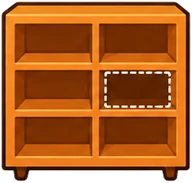


The game works your visual memory for objects: in a few seconds you need to remember what’s in the cabinet, and then notice what’s gone. On the first levels, some of the answer options are items still on the shelves. Later, the shelves hold items from three groups, and the answer options look like the missing item, so a vague “I think I saw that somewhere” won’t get you through.
The difficulty adapts: a correct answer adds items, a mistake removes some. Once you sign up, every game is saved, and your account shows a chart.
Remember a set of objects in a few seconds.
Notice what’s gone, which is harder than noticing something new.
Every correct answer puts more items on the shelves.
The options look alike: two of the four never left the cabinet.
Look at the shelves for as long as you need and press “Got it”. Then the two minutes begin.
After that, the cabinet closes on its own after 4–7 seconds: the more items, the longer you see them.
The cabinet opens again with one item gone. There are four options below.
Correct: the next round has more items. Wrong: we show you what was missing, and there will be fewer items.
The more items on the shelves, the more points a correct answer earns: from 1 with four items to 6 with fifteen. Mistakes don’t cost you points.
Press “Start”, memorize the items on the shelves, and pick the one that disappeared.
What’s Missing?
Items sit on the shelves of a cabinet. Remember them: the cabinet closes and one item disappears. Pick what’s missing.
Free play left today without signing up: 10 min
This is a well-known memory and observation game. It’s often called Kim’s game, after Rudyard Kipling’s novel “Kim”, in which the hero is trained to memorize objects on a tray. The idea is the same: look at a set of items, turn away, and say what changed.
A similar picture game, but about finding pairs, is “Find the Pair”. And if you’d like to work your memory for places rather than objects, try “Remember the Color”.
Two minutes for visual memory and attentiveness. Works well as a short break.

Kids know this game from kindergarten, and the first round has no time limit. Part of the “Kids” collection. Suitable from age 6. Kids set

Clear rules and an unhurried first round. After a mistake there are fewer items, so the game moves at your pace. Part of the “60+” collection. 60+ set
Answer 4 questions and we’ll put together a daily program of 5 trainers. We’ll email you the full 2-week plan.
Question 1 of 4
In the first round, as long as you like: the cabinet closes when you press “Got it”. After that, 4 to 7 seconds depending on the number of items.
We show you which item was missing, and the next round has fewer items. Mistakes don’t cost you points.
On the first levels, two of the four options are still on the shelves, and one was never there at all. Then only one stays, and from level five none of the options are on the shelves: all four look like the missing item from the same group. That way the game checks whether you remember the set, not just whether you recognize familiar pictures.
No, you can play 10 minutes a day right away. Free sign-up lets you keep playing, save your results, track your progress and unlock the daily workout.
Yes, the game runs in the browser on a phone, tablet or computer. There’s nothing to install.
All exercises for this skill: Memory trainers online
Free sign-up: round history, a chart by skill and a daily workout of 5 exercises. No credit card needed.
 Schulte Table
 Schulte Table 5×5
 Shuffling Schulte Table
 Stroop Test
 Stop Signal
 Gorbov–Schulte Table
 Symbol Coder
 Wide View
 Emotions
 Spot the Difference
 Odd One Out
 Visual Search
 Count the Shapes
 More Dots
 Two of a Kind
 Middle Arrow
 Tagged Fish
 Shell Game
 Reaction Test
 Landolt Rings Test
 Click Speed
 Aim Trainer
 Color Blind Test
 Hearing Test
Sign up — it’s free: 10 minutes of play every day, plus history and progress.
While you think it over, read what this exercise trains.
 Find the Pair
 Remember the Color
 Corsi Blocks
 Remember the Number
 Digits Backward
 N-back
 N-back 2
 N-back 3
 Backward Corsi Blocks
 Color Melody
 Pattern Memory
 Digit Span Test
 Chimp Test
 Repeat the Sequence
 Visual Memory
 Task Switcher
 Stroop: Color or Word
 Connect in Order
 Card Sorter
 Same Shape
 Meaning and Color
 Quick Math
 Addition and Subtraction
 Times Tables
 Division Facts
 Greater or Less
 Making Change
 True or False
 Balance
 2048 Online
 Number Sequences
 Tower
 Scales
 Patterns
 Mini Sudoku
 Missing Piece
 Connect the Pairs
 Logic Test
 IQ-Style Test
 Shape Rotation
 Follow the Arrows
 Maze
 Count the Corners