
Adults
A two-minute planning puzzle: you can take it calmly, since points depend on more than speed.
Also known as: Tower, ball puzzle, Tower of London test
Move the balls between three pegs until they match the target picture. A round lasts two minutes, puzzles come one after another, and the fewer extra moves you make, the more points you get. You can play 10 minutes a day without signing up.
Go to the game ↓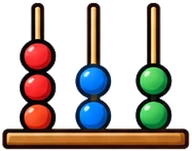


The exercise puts your planning to work: before you pick up a ball, it pays to think through the whole chain of moves. The pegs have different heights and hold three, two and one ball, so the direct route often doesn’t work and you first have to make room.
In your account the trainer is called “Tower”. Once you sign up, your rounds are saved: you see how many puzzles you solved, how many with no extra moves and how long the puzzles got, and a 30-day chart shows how your score changes.
Think through the chain of moves before you pick up the first ball.
Keep track of where each ball will be two or three moves from now.
Resist the obvious move if it takes you away from the goal.
The move counter next to the minimum shows how precise your solution was.
The target picture is shown at the top, with your pegs below it. A hint tells you in how many moves the puzzle can be solved.
Tap a peg and its top ball lifts up. You can only take the top ball.
Tap another peg and the ball lands on top. The pegs hold three, two and one ball; you can’t put a ball on a full peg.
If you get tangled up, press “Reset the balls”, and the puzzle starts over. The move counter isn’t reset.
Solve it in the minimum number of moves and the next puzzle is one move longer. Make three or more extra moves and it’s one move shorter. The longer the puzzle and the fewer extra moves, the more points you get.
Tap a peg to pick up a ball and another peg to put it down. Without signing up you get 10 minutes of play a day.
Tower
Move the balls to match the target picture. You can only take the top ball. The fewer moves, the more points.
Free play left today without signing up: 10 min
The Tower of London was proposed by British neuropsychologist Tim Shallice in the early 1980s as a planning task. The classic version is the same as here: three balls of different colors and three pegs that hold three, two and one ball.
The puzzle is similar to the Tower of Hanoi, but there the disks differ in size and a larger one can’t go on a smaller one. If you like thinking several moves ahead, try 2048 Online.
A two-minute planning puzzle: you can take it calmly, since points depend on more than speed.

The trainer isn’t in the “Kids” collection. The rules are clear, but long puzzles take planning many moves ahead. Better for older children.

The trainer isn’t in the “60+” collection. If you like calm puzzles, give it a try: each round starts with two-move puzzles, and they only get longer once you solve them with no extra moves.
Answer 4 questions and we’ll put together a daily program of 5 trainers. We’ll email you the full 2-week plan.
Question 1 of 4
Solve it with no extra moves and you get three times as many points as the puzzle has moves: 12 points for a 4-move puzzle. Extra moves mean fewer points, but a solved puzzle always gives at least one.
The puzzle still counts. With one or two extra moves the next puzzle stays the same length; with three or more it gets one move shorter.
In the Tower of Hanoi the disks differ in size, and a larger one can’t go on a smaller one. In the Tower of London the balls differ in color and the pegs differ in height: they hold three, two and one ball.
No, you can play 10 minutes a day right away. A free account lets you keep playing, save your results, track your progress and unlock the daily workout.
Yes, the trainer runs in the browser on phones, tablets and computers. There’s nothing to install.
 2048 OnlinePlanning, puzzle
 Number SequencesPatterns in numbers
 Raven’s MatricesPatterns in shapes
 Wisconsin Card Sorting TestMental flexibility
All exercises for this skill: Logic Trainers online
Free sign-up: round history, a chart by skill and a daily workout of 5 exercises. No credit card needed.
 Schulte Table
 Schulte Table 5×5
 Shuffling Schulte Table
 Stroop Test
 Stop Signal
 Gorbov–Schulte Table
 Symbol Coder
 Wide View
 Emotions
 Spot the Difference
 Odd One Out
 Visual Search
 Count the Shapes
 More Dots
 Two of a Kind
 Middle Arrow
 Tagged Fish
 Shell Game
 Reaction Test
 Landolt Rings Test
 Click Speed
 Aim Trainer
 Color Blind Test
 Hearing Test
Sign up — it’s free: 10 minutes of play every day, plus history and progress.
While you think it over, read what this exercise trains.
 Remember the Number
 Digits Backward
 Remember the Color
 Find the Pair
 N-back
 N-back 2
 N-back 3
 Corsi Blocks
 Backward Corsi Blocks
 What’s Missing?
 Color Melody
 Pattern Memory
 Digit Span Test
 Chimp Test
 Repeat the Sequence
 Visual Memory
 Task Switcher
 Stroop: Color or Word
 Connect in Order
 Same Shape
 Meaning and Color
 Quick Math
 Addition and Subtraction
 Times Tables
 Division Facts
 Greater or Less
 Making Change
 True or False
 Balance
 Scales
 Mini Sudoku
 Missing Piece
 Connect the Pairs
 Logic Test
 IQ-Style Test
 Shape Rotation
 Follow the Arrows
 Maze
 Count the Corners