
Adults
A good fit if you want a timed logic check: 20 tasks, 15 minutes and a scale for reference.
Also known as: Logic test, logical reasoning test, 20 matrices test, abstract reasoning test with shapes
Twenty 3 × 3 grids, each with one empty cell. In each one you find the rule and choose the missing figure from six options. Tasks go from easy to hard, and you have 15 minutes for the whole test. The result is the number of correct answers and a rating on the trainer’s scale. You get your result for free after entering your email: we show it on screen and send it to your inbox.
Go to the game ↓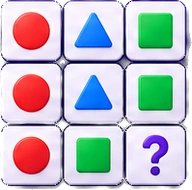


The test checks how you find patterns in shapes. Across the grid, the shape, color, number and size of the figures change, and sometimes so do small marks in the corners. You need to work out the rule each feature follows across rows and columns and apply it to the empty cell.
This isn’t a clinical test and it doesn’t measure IQ. The result shows how many tasks you solved in this trainer and compares it with our scale. Once you sign up, your attempts are saved, so you can see how your result changes from one attempt to the next.
Notice exactly what changes from cell to cell.
In hard tasks, shape, color, number and marks change by different rules.
In some tasks the third cell of a row comes from the first two.
Wrong answers look like the right one and break one or more rules.
Press “Start”. A 15-minute timer begins, and the first of 20 tasks appears.
Look at the 3 × 3 grid. The bottom-right cell is empty. Compare the cells across rows and down columns.
Work out how each feature changes: shape, color, number of figures, size, marks in the corners. The rules vary: a feature depends on the row or the column, each value appears once in every row and column, values alternate, add up or subtract.
Choose one of six options. Your answer is recorded right away and the test moves on to the next task. We don’t show whether it was right along the way. You can skip a task.
After 20 tasks, or when the timer runs out, you’ll see the number of correct answers, your results by difficulty level, the time spent, the number of skips and a rating on the trainer’s scale.
Solve 20 matrices in 15 minutes. Press “Start” as soon as you’re ready: the clock starts with the first task.
Logic Test
20 3×3 matrices with an empty cell, 15 minutes. In each, find the rule and pick the missing shape from six options. The tasks go from easy to hard; you won’t see whether you’re right along the way.
Free play left today without signing up: 10 min
The format is close to J. C. Raven’s matrix tests (1936): a grid of figures with a gap, plus answer options. Here the tasks are created by a generator following our own rules, and within the test’s rule system exactly one option out of six fits the conditions: the program checks this. It’s a trainer built on the method’s format, not the original Raven test.
The scale by number of correct answers: 17–20 is very high, 13–16 high, 9–12 average, 5–8 below average, 4 or fewer low. This is the trainer’s own guide, not a diagnosis and not an IQ score. Your result is affected by fatigue, noise around you and how used you are to tasks like these. To look for patterns in numbers, try Number Sequences; in patterns, try Missing Piece; and the Patterns exercise lets you practice without the test’s time limit. Mini Sudoku and Scales make a good warm-up.
A good fit if you want a timed logic check: 20 tasks, 15 minutes and a scale for reference.

Not in the “Kids” collection. For schoolchildren the trainer has a shorter version: 12 matrices in 10 minutes, using only the first 10 difficulty levels.

Not in the “60+” collection. The test is designed for 15 minutes with no breaks. If you’d rather practice at a calmer pace, start with the Patterns exercise.
Answer 4 questions and we’ll put together a daily program of 5 trainers. We’ll email you the full 2-week plan.
Question 1 of 4
No. It’s a rating of logical reasoning on our own scale, not an IQ test and not a diagnosis. The result shows how many tasks you solved in this trainer and depends on fatigue, attention and experience.
The exercise runs for two minutes, the difficulty adapts to you, and after a mistake you see the right answer. The test has 20 tasks of increasing difficulty, 15 minutes in total, no hints along the way and a final rating on the scale.
You can skip, but you can’t go back to a skipped task: answers are recorded right away. A skip doesn’t cost points, but it doesn’t earn any either. If time runs out, unanswered tasks count as skipped.
Within the test’s rule system, yes. A generator creates the tasks, and the program checks that only one of the six options fits all the task’s rules. Wrong options differ from the right one in one to three features, and some of them look more like the neighboring cells than the right answer does, so it’s hard to guess by visual similarity. Luck still plays a part, though: a random pick out of six is right one time in six.
You can start without signing up. Play without an account is limited to 10 minutes a day, and the test takes up to 15, so it’s best to sign up to complete it in full and save your results.
 Raven’s MatricesMatrix practice without limits
 Missing PieceA pattern with a missing piece
 Number SequencesPatterns in numbers
 Tower of LondonPlanning moves
All exercises for this skill: Logic Trainers online
Free sign-up: round history, a chart by skill and a daily workout of 5 exercises. No credit card needed.
 Schulte Table
 Schulte Table 5×5
 Shuffling Schulte Table
 Stroop Test
 Stop Signal
 Gorbov–Schulte Table
 Symbol Coder
 Wide View
 Emotions
 Spot the Difference
 Odd One Out
 Visual Search
 Count the Shapes
 More Dots
 Two of a Kind
 Middle Arrow
 Tagged Fish
 Shell Game
 Reaction Test
 Landolt Rings Test
 Click Speed
 Aim Trainer
 Color Blind Test
 Hearing Test
Sign up — it’s free: 10 minutes of play every day, plus history and progress.
While you think it over, read what this exercise trains.
 Remember the Number
 Digits Backward
 Remember the Color
 Find the Pair
 N-back
 N-back 2
 N-back 3
 Corsi Blocks
 Backward Corsi Blocks
 What’s Missing?
 Color Melody
 Pattern Memory
 Digit Span Test
 Chimp Test
 Repeat the Sequence
 Visual Memory
 Task Switcher
 Stroop: Color or Word
 Connect in Order
 Card Sorter
 Same Shape
 Meaning and Color
 Quick Math
 Addition and Subtraction
 Times Tables
 Division Facts
 Greater or Less
 Making Change
 True or False
 Balance
 2048 Online
 Scales
 Mini Sudoku
 Connect the Pairs
 IQ-Style Test
 Shape Rotation
 Follow the Arrows
 Maze
 Count the Corners