
Adults
A check of your short-term memory for digits and a workout for attention.
Also known as: digit span test online, short-term memory span test, number memory test, how many digits can you remember
A number with several digits appears for a second. Memorize it and type it from memory in the same order. After five correct answers in a row the number gets longer, after three mistakes it gets shorter. We start with three digits. No sign-up needed. Your result is free once you enter your email: we’ll show it to you and send it to your inbox.
Go to the game ↓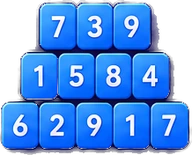


The test estimates your short-term memory span for digits: how many digits in a row you can hold and repeat after one brief look. Your result is the longest sequence you recalled without a mistake.
Most adults can hold about five to nine digits, but the result depends on attention, tiredness and memory techniques (such as splitting the number into groups). It isn’t a diagnosis: the test helps you compare your own games with each other.
How many digits you hold after one look.
The number is shown for about a second, so stay focused.
Splitting digits into groups of two or three helps a lot.
A mistake doesn’t end the game: the number just gets shorter.
Press “Start”. A three-digit number appears for a second.
Look at the digits and try not to repeat them to yourself too fast; splitting them into groups works better.
Type the number from memory on the on-screen keypad or your computer keyboard, in the same order.
Five correct answers in a row make the number one digit longer; three mistakes in a row make it shorter.
Press “Start” and memorize the number. You can play 10 minutes a day without signing up.
Digit Span Test
A number shows for a second. Type it in the same order. Five correct answers in a row make the number longer; three mistakes in a row make it shorter. You start with three digits.
Free play left today without signing up: 10 min
Psychologists have studied memory for digits since the second half of the 19th century. One of the first to describe such a task was the British scholar Joseph Jacobs: schoolchildren had rows of digits read to them, and he noted how long a row they could repeat. Later the test became part of many batteries for assessing memory and attention.
In our version, the number is shown on screen for a short time instead of being read aloud. It doesn’t replace standardized tests and doesn’t assess your health. If you’d like the backward version, open “Digits Backward”.
A check of your short-term memory for digits and a workout for attention.

Suitable for school-age kids who know their digits and can type them quickly.

A big keypad with large digits, and no rush: after the number is shown, you have plenty of time to type it.
Answer 4 questions and we’ll put together a daily program of 5 trainers. We’ll email you the full 2-week plan.
Question 1 of 4
Most adults manage about five to nine digits in a row after one look. If you split the number into groups, you can do noticeably more. This is a rough guide that depends on attention and memory technique.
The rules are the same. Here the game starts with three digits and is set up as a classic memory span test, while the game’s difficulty is tuned for practice.
No. Type them the way they were shown. For the reverse order there’s a separate game, “Digits Backward”.
The game doesn’t stop. Three mistakes in a row make the number shorter, and five correct answers in a row make it longer. Your result is the longest number you typed correctly.
No. It’s a game version of a memory task. It doesn’t diagnose anything and doesn’t replace a doctor’s advice.
All exercises for this skill: Memory trainers online
Free sign-up: round history, a chart by skill and a daily workout of 5 exercises. No credit card needed.
 Schulte Table
 Schulte Table 5×5
 Shuffling Schulte Table
 Stroop Test
 Stop Signal
 Gorbov–Schulte Table
 Symbol Coder
 Wide View
 Emotions
 Spot the Difference
 Odd One Out
 Visual Search
 Count the Shapes
 More Dots
 Two of a Kind
 Middle Arrow
 Tagged Fish
 Shell Game
 Reaction Test
 Landolt Rings Test
 Click Speed
 Aim Trainer
 Color Blind Test
 Hearing Test
Sign up — it’s free: 10 minutes of play every day, plus history and progress.
While you think it over, read what this exercise trains.
 Remember the Number
 Digits Backward
 Corsi Blocks
 Remember the Color
 Find the Pair
 N-back
 N-back 2
 N-back 3
 Backward Corsi Blocks
 What’s Missing?
 Color Melody
 Pattern Memory
 Chimp Test
 Repeat the Sequence
 Visual Memory
 Task Switcher
 Stroop: Color or Word
 Connect in Order
 Card Sorter
 Same Shape
 Meaning and Color
 Quick Math
 Addition and Subtraction
 Times Tables
 Division Facts
 Greater or Less
 Making Change
 True or False
 Balance
 2048 Online
 Number Sequences
 Tower
 Scales
 Patterns
 Mini Sudoku
 Missing Piece
 Connect the Pairs
 Logic Test
 IQ-Style Test
 Shape Rotation
 Follow the Arrows
 Maze
 Count the Corners